Hillsboro: Typical Home’s Utility Bill Would Rise $4.18 a Month in 2027 Under Rate Plans

- A single-family Hillsboro home would pay $4.18 more a month on its city utility bill starting Jan.
- The example is a home using 8 ccf of water a month, about 6,000 gallons.
- Source: City of Hillsboro Finance Committee packet, Oct.
A single-family Hillsboro home would pay $4.18 more a month on its city utility bill starting Jan. 1, 2027, under rate plans in two Oct. 13 city meeting packets. Another $6.57 a month would follow on Jan. 1, 2028, taking the city’s example bill from $149.71 today to $153.89 and then $160.46.
The example is a home using 8 ccf of water a month, about 6,000 gallons. The water staff report calls that a typical customer. Over 2027, the increase adds up to $50.16. By 2028, the bill would be $10.75 a month above today’s, or $129 a year (our calculations, monthly change × 12).
| Monthly charge | Now | Jan. 1, 2027 | Jan. 1, 2028 | Who sets it |
|---|---|---|---|---|
| Water (Hillsboro Water, 8 ccf) | $56.22 | $58.46 | $60.81 | Utilities Commission |
| Sewer, city share | $13.19 | $13.83 | $14.50 | City Council |
| Stormwater, city share | $15.48 | $16.25 | $17.06 | City Council |
| Street (transportation utility) fee | $10.60 | $11.13 | $11.69 | City Council |
| Sewer, Clean Water Services share | $51.13 | $51.13 | $53.19 | Clean Water Services |
| Stormwater, Clean Water Services share | $3.09 | $3.09 | $3.21 | Clean Water Services |
| Total | $149.71 | $153.89 | $160.46 |
Source: City of Hillsboro Finance Committee packet, Oct. 13, 2026, pp. 73–74, 82, 85; Utilities Commission packet, Oct. 13, 2026, pp. 18, 27. The totals are the city’s, and the six lines add up to them.
None of these rates is final in the records reviewed for this story. The City Council sets the city’s sewer, stormwater and street fees. On Oct. 13, staff asked the Finance Committee to forward a recommendation on sewer and stormwater. A city timeline sends the street fee to the Transportation Committee on Oct. 27, ahead of a council first reading on Nov. 3.
Water belongs to the Utilities Commission. It was scheduled to vote on Resolution 251-W, the 2027 and 2028 water rates, on Oct. 13. Clean Water Services, the regional sewer agency, sets its own share each July 1.
Its lines do not change in the slide’s 2027 column. That leaves all of the first year’s $4.18 with city-set charges: $2.24 for water and $1.94 for the three fees (our calculation). In 2028, about $2.18 of the $6.57 comes from higher Clean Water Services lines. The slide does not say whether those are estimates.
Paving costs that more than doubled
The street fee, which the city calls the transportation utility fee, helps pay for street work. Staff slides say the pavement program needs “$8.5m per year” to keep streets at a condition score of 80 and clear deferred maintenance. They propose ramping up to that level over 10 years.
Costs have climbed in the meantime. A square yard of road overlay cost $26.85 in 2019 and $69.52 in 2026. An ADA ramp went from $4,000 to $7,700. The slides also describe nearly flat state and county revenue, and note that a state measure, HB 3991, went to voters in May and failed.
The residential plan is 5% a year for three years, then 4% for two, reaching $13.27 by 2031. Only the 2027 and 2028 rates are up for adoption now. Households with no vehicle or an annual TriMet pass can get a 30% discount. The program has had fewer than 10 participants in recent years.
A railroad culvert and a slower sewer plan
Stormwater has its own pressure point. The Glencoe Swale runs under the BNSF railroad embankment through a 3-by-5-foot wooden box culvert. Staff say the culverts cannot carry the stream in large storms without significantly raising water levels upstream.
Staff list a FEMA grant of about $18 million, and the proposed rates are “inclusive of” it. Even so, a slide says the stormwater master plan and the Glencoe project cause “immediate cash flow issues requiring increases.” On the sewer side, master plan projects are now spread over 20 years instead of 10 to 15.
Both proposals are lower than the 2024 rate study projected for 2027. That study had sewer at $14.28 and stormwater at $17.03, against the current proposals of $13.83 and $16.25. The staff memo says the city delayed projects to lower rate increases.
Industry pays more for a north Hillsboro pipeline
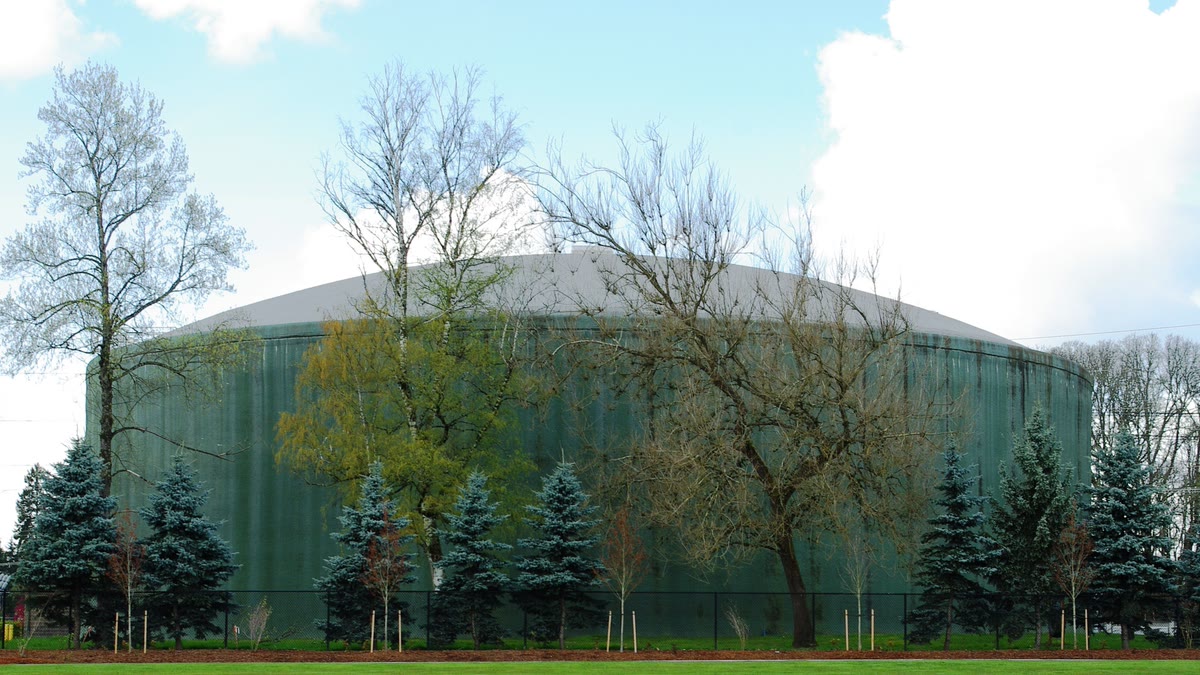
For water, staff recommend Option 2. It raises retail rates about 4% a year and Industrial and Large Industrial rates about 6.5%. The staff report gives the reason: the capital plan includes a large water line that “will primarily benefit” the industrial cluster in north Hillsboro.
That project was deferred to about 2030. Hillsboro’s share is “estimated at $60 to $75 million.” It would be paid about 60% from system development charges, the one-time fees on new connections, and 40% from rates.
The two industrial classes brought in about 39.7% of the $52.9 million in FY 2026 water revenue that staff used. Under Option 2, they would supply about 52% of the estimated added revenue in 2027. They also account for nearly all of the $545,559 that Option 2 raises beyond the rate study’s 4% (our calculations).
The city’s survey drew 74 responses, and 52.3% chose Option 2. Draft minutes show no members of the public testified at the Sept. 28 hearing. If commissioners picked another option, staff would bring a revised resolution on Nov. 12.
How the bill compares with Beaverton and Tigard
The city’s slides set Hillsboro’s proposed charges, which match the 2027 figures, beside neighbors’ rates. Hillsboro’s street fee would be $11.13, against $5.00 in Beaverton and $14.29 in Tigard. Staff note that such fees are only one way cities pay for roads.
With Clean Water Services’ share included, Hillsboro’s sewer bill would be $64.96. That compares with $63.24 in Beaverton and $63.84 in Tigard. Its stormwater bill would be $19.34, against $14.66 and $17.25. The proposed $58.46 water bill is below a $66.29 regional average built from other providers’ 2026 rates.
Where residents can speak
The Transportation Committee takes up the street fee on Oct. 27, and the council’s first reading is set for Nov. 3. Recent city agendas ask remote speakers to register with the City Recorder’s Office by 3 p.m. the day of the meeting. The contacts are [email protected] and 503-681-6269.
Hillsboro Water says it takes comments year-round at 503-615-6700 or [email protected]. For households that need help, the city offers bill relief of $300 to $500, depending on household size, through three community partners. Payment plans are available at 503-681-6163.
