Hillsboro: $621,711 in Water Charges Was More Than 120 Days Past Due on Aug. 31

- Hillsboro water customers owed the city $3,240,180 at the end of August, and $621,711 of that had been unpaid for more than 120 days.
- An aging report sorts unpaid dollars by how long they have been owed, from "current" through "over 120" days.
- It also covers water alone.
Hillsboro water customers owed the city $3,240,180 at the end of August, and $621,711 of that had been unpaid for more than 120 days. The figures come from a Water Department aging report in the Utilities Commission’s Oct. 13 meeting packet, and by our calculation 84.5% of the oldest balance is residential.
An aging report sorts unpaid dollars by how long they have been owed, from “current” through “over 120” days. It counts money, not people. The report does not say how many accounts or households are behind, and it does not say whether the oldest balances belong to accounts that have since closed.
It also covers water alone. Every line is a water charge or fee, though the city’s bill also carries other charges, such as sewer charges collected for Clean Water Services.
The oldest balance barely moved
A month earlier, the old end of the ledger looked almost the same. The July 31 report in the commission’s Sept. 15 packet showed $2,907,430 owed in total and $619,202 over 120 days. By our math, the total rose $332,750 in a month, while the over-120 balance rose $2,509.
Most of that growth came in the newest buckets. Current charges climbed from $1,992,061 to $2,197,213, and charges 1 to 30 days late went from $228,856 to $297,377. Measured against that larger total, the over-120 share of everything owed fell from 21.3% in July to 19.2% in August, our calculation.
In four groups, the over-120 figure was identical to the dollar in both months: industrial, nonprofit, private fire protection and the fee lines. The reports do not explain this, and the staff report on the financial item does not mention the aging figures. The same packet carried the water rate resolutions the commission was scheduled to consider for 2027 and 2028, covered in our Oct. 19 story on proposed utility rates.
Where the old debt sits
Sorted by customer type, the old balance sits mostly with residential customers. The table combines each class’s lines inside the city and in the “upper system,” which the city’s rate rules describe as outside city limits.
| Customer class | Total due, Aug. 31 | Over 120 days, July 31 | Over 120 days, Aug. 31 | Share of all 120+ debt, Aug. |
|---|---|---|---|---|
| Residential | $2,247,251 | $522,863 | $525,416 | 84.5% |
| Commercial | $284,449 | $42,393 | $42,151 | 6.8% |
| Irrigation | $507,519 | $30,806 | $30,831 | 5.0% |
| Industrial | -$26,228 | $8,673 | $8,673 | 1.4% |
| Fee lines | $8,638 | $8,438 | $8,438 | 1.4% |
| Multifamily | $146,068 | $4,333 | $4,504 | 0.7% |
| Private fire protection | $13,057 | $1,448 | $1,448 | 0.2% |
| Nonprofit | $28,513 | $249 | $249 | under 0.1% |
| Public | $30,915 | $0 | $0 | 0% |
| All classes (report total) | $3,240,180 | $619,202 | $621,711 | 100% |
Our calculation from the July 31 (Sept. 15 packet, pp. 21-22) and Aug. 31 (Oct. 13 packet, pp. 73-74) aging reports, adding each class’s base and usage lines from both pages. Fee lines are meter tampering, meter removal and two disconnect or reconnect fees. Shares divide by $621,711. Sums can differ from printed totals by $1 or $2, as the report’s own rows do. The negative industrial total reflects a negative base balance the report does not explain.
For residential customers, $525,416 of the $2,247,251 owed was more than 120 days old, or 23.4% by our math. That is down from 25.2% in July. Usage charges made up $311,520 of the old residential balance and base charges $213,896.
Help the city offers on overdue bills
The same Oct. 13 packet ends with a flyer, on p. 97, for the city’s Utility Bill Assistance program, which offers payment plans and bill relief. A city finance slide says the relief can reduce “past-due and/or current utility bills.”
Relief is $300 for households of one to four people, $400 for five to eight and $500 for nine or more. The city’s assistance page, checked Oct. 26, lists those amounts per 12-month period.
To qualify, you must be listed on the utility bill and meet one of two tests. One is enrollment in a program such as SNAP, WIC, TANF, the Oregon Health Plan, free or reduced lunch, energy assistance, or public housing or Section 8. The other is household income at or below 60% of Oregon median income over the past 30 days, which the page puts at $38,385 a year for one person and $73,817 for four.
Eligibility is verified by one of three community partners: Community Action, Centro Cultural or the Salvation Army. The city’s Utility Billing team then contacts the customer to confirm the credit.
Payment plans have their own rules. The flyer says you must not have defaulted on a prior plan in the last 12 months or have a past-due account sent to debt collection. The city page says customers in collection must pay the agency or set up a plan with it first. A separate transportation utility fee discount has had fewer than 10 participants in recent years, the finance slides say.
How to ask for help
- Payment plan: call Utility Billing at 503-681-6163 or visit the Civic Center, 150 E Main St., first floor, 8 a.m. to 5 p.m. weekdays. Staff speak English and Spanish.
- Bill relief: verify first with Community Action (503-648-6646, online, in person or by mail), Centro Cultural (503-336-9895) or the Salvation Army (503-640-4311).
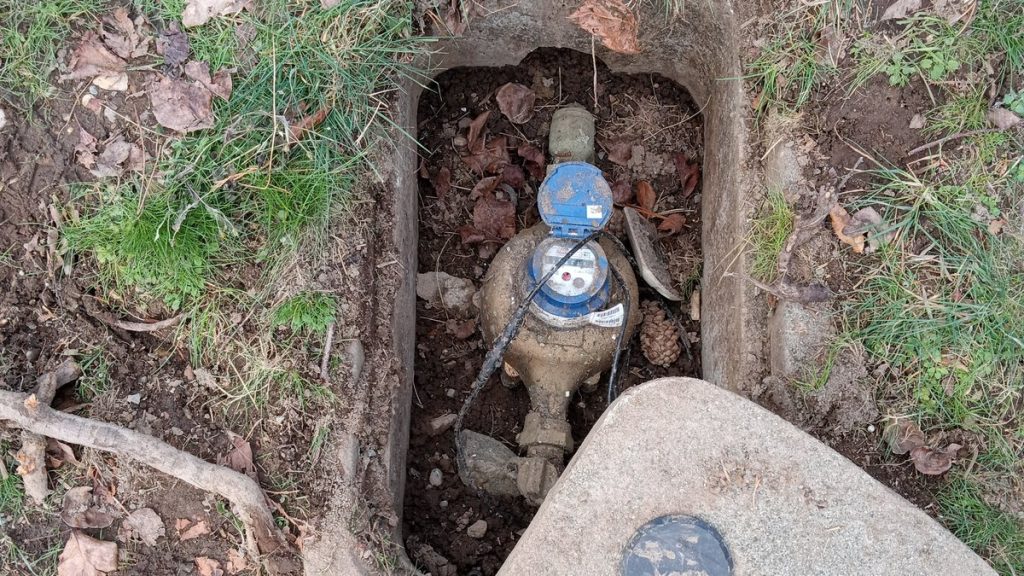
Top image: Illustrative image, 2024: a residential water meter in an open meter box in Federal Way, Washington. Photo: Gayest Frogs, CC BY-SA 4.0, via Wikimedia Commons (cropped).
