Hillsboro: School District Reports Regular Attendance at 68.4%, Short of Its 80% Goal

- Hillsboro School District reports that about 68.4% of its students attend school regularly, up from roughly 64.5%, but still short of the 80% it wants to reach by 2028.
- It sits on pages 62 to 67 of the Oct.
- The attendance goal uses a state definition.
Hillsboro School District reports that about 68.4% of its students attend school regularly, up from roughly 64.5%, but still short of the 80% it wants to reach by 2028. The figures appear in the district’s 2025-26 Integrated Programs Annual Report, which the school board will hear on Tuesday, Oct. 27.
It sits on pages 62 to 67 of the Oct. 27 board packet, under item G.2, the first accountability report of the school year. The agenda gives it 30 minutes starting at about 7:40 p.m., with Assistant Superintendent Brooke Nova, Becky Kingsmith and Gina McLain presenting.
What counts as regular attendance
The attendance goal uses a state definition. The Oregon Department of Education counts students as regular attenders if they attended more than 90% of their enrolled school days. Students must be enrolled for at least 75 days to be counted.
The district report does not say which school years its 64.5% and 68.4% figures cover. ODE’s published files show Hillsboro at 64.6% in 2022-23, 69.6% in 2023-24 and 68.2% in 2024-25, when 12,308 of 18,051 counted students were regular attenders. ODE’s page, checked Oct. 25, lists files only through 2024-25. Measured against the goal, 68.4% leaves 11.6 percentage points to go, by our calculation.
The report credits better attendance dashboards, quarterly messages to families and more family outreach. It also links attendance work to mental health help and McKinney-Vento supports, the federal program for students without stable housing. Families, it says, have faced food and financial insecurity and “impacts from immigration activity in our community.”
The report’s measures side by side
The district’s growth targets, developed with and approved by ODE, run from 2023-24 through the 2027-28 school year, the report says. The table below lists every student-outcome measure in the report that carries a percentage.
| Measure | Latest | Prior | Target |
|---|---|---|---|
| Regular attendance, district | about 68.4% | about 64.5% | 80% by 2028 |
| Ninth grade on track, district | 89% | 92% | not stated |
| Ninth graders earning 3.5+ core credits | 84.1% (2025-26) | 83.8% (2024-25), 82.6% (2023-24) | not stated |
| Third-grade reading, district | 37.8% | not stated | 40% |
| Third-grade reading, City View Charter | 44% | not stated | 50% |
Source: HSD 2025-26 Integrated Programs Annual Report, Oct. 27 board packet, pp. 63–65. The report gives school years only for the core-credit measure.
Ninth graders and third-grade readers
For ninth graders, the overall on-track measure fell from 92% to 89%, while an internal measure grew. That one counts students who earn at least 3.5 core credits, in math, language arts, social science and science, out of the 6 credits needed to be on track.
The report credits that growth to teacher teams that share teaching goals and biweekly grade-level meetings that use student data. Third-grade reading, by contrast, sits under the report’s question about barriers and challenges. It says the district saw a slight increase but missed its 40% target, adding that it was “just 0.2 shy with 37.8%.” The gap between those two figures is 2.2 points, by our calculation, and the report does not explain the difference.
ODE’s own district file, used in our story on 2025-26 state test results, lists 36.9% of Hillsboro third graders meeting the reading standard in 2025-26, down from 37.2%. The report does not say which data its 37.8% comes from. It notes that English learners can take up to seven years to become proficient and that students in special education remain a challenge. City View Charter School reported 44% against its 50% target.
Shuttles, apprentices and clinical placements
The report’s section on career and technical education, or CTE, lists student counts rather than targets. More than 200 students each semester used the CCP Shuttle to reach specialized CTE programs. In health sciences, 109 seniors took credential courses, and 224 students completed clinical or workplace placements during 2025-26.
Those students earned credentials in medical assisting, phlebotomy, pharmacy technology, dental assisting, bioscience and Basic Life Support. In a second group of registered youth apprentices, supported by the Oregon Bureau of Labor and Industries and Jireh Semiconductor, four students logged more than 2,100 paid work hours combined while finishing high school CTE courses.
Trades and construction students had internships through CBRE, and bioscience students joined a Genentech mentorship program for the third year in a row. The report also says Fire Science students were placed and employed by Hillsboro Fire & Rescue and wildland firefighting groups.
Before the report on Oct. 27
The report comes after a consent agenda that asks the board to accept two gifts: $100,000 from the Hillsboro Schools Foundation for Choice Funds and $10,000 from a private donor for Lenox Elementary’s band. The cover memo also says staff will review interim assessment data, now part of this report under Senate Bill 141, and report progress on its 2023-2027 strategic plan goals. The packet does not include either.
The board meets at the Administration Center, 3083 NE 49th Place, with a 5:15 p.m. work session and a 7 p.m. regular session. Audience Time, the public comment period, is set for 7:20 p.m. Under the district’s public comment rules, in-person speakers fill out an Intent to Speak form in the room by 7 p.m., and remote speakers sign up by 4 p.m. through a Google form.
The board asks that comments run three minutes or less, and the agenda says times may shift. A livestream link goes up at the top of the district website that morning. Interpretation can be requested by calling 503-844-1429 at least 48 hours before the meeting.
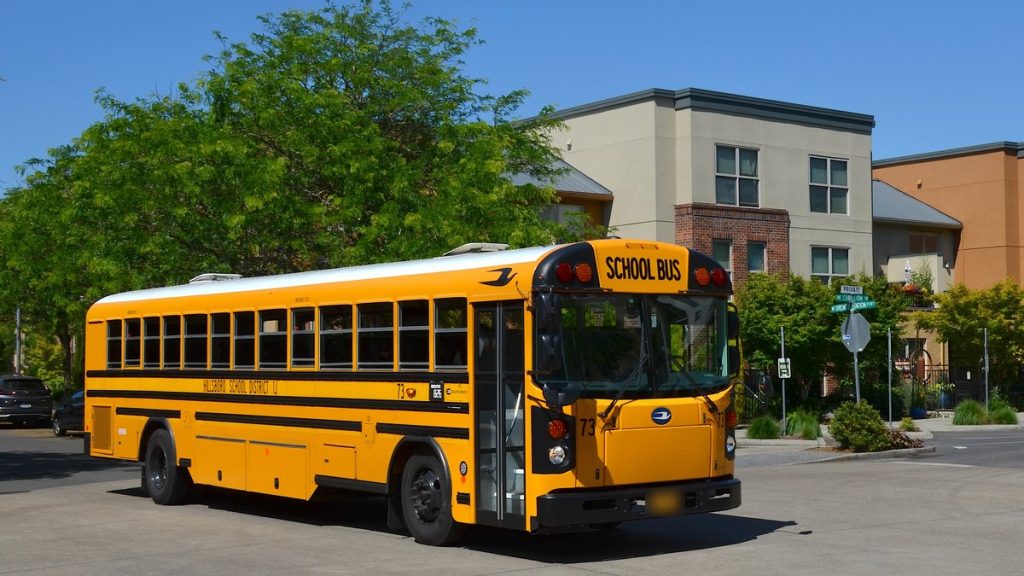
Top image: File photo, 2023: a Hillsboro School District bus on Orenco Station Parkway. Photo: Steve Morgan, CC BY-SA 4.0, via Wikimedia Commons (cropped, license plate blurred).
