Hillsboro: Council Adopts Data Center Caps 6-0; Moratorium Extension Vote Expected Later

- Hillsboro City Council voted 6-0 on Oct.
- Councilor Elizabeth Case moved to adopt the ordinance and Councilor Kipperlyn Sinclair seconded it, the city's video of the meeting shows.
- The start date is set by Section 6 of the ordinance in the Oct.
Hillsboro City Council voted 6-0 on Oct. 20 to adopt Ordinance 6521, which limits where new data centers and battery storage sites can go and how much land they can use. The new code is adopted but not yet in force, and the city says the council is expected to consider extending its data center moratorium at an upcoming meeting.
Councilor Elizabeth Case moved to adopt the ordinance and Councilor Kipperlyn Sinclair seconded it, the city’s video of the meeting shows. All six voted yes in a roll call that closed the item at 1:57:06 in the recording, about seven minutes after it opened. The adopted text is the “as amended” version in our preview of the vote, with standalone data centers limited to two industrial zones under acreage caps.
Counting the 30 days
The start date is set by Section 6 of the ordinance in the Oct. 20 council packet. It makes the ordinance effective “30 days following its passage and approval by the Mayor.” The packet copy fills in Oct. 20 as the date of Mayor Beach Pace’s approval, though its signature line is blank.
If the mayor approved it that night, the count runs 11 days to the end of October and 19 more into November. That puts the 30th day at Thursday, Nov. 19, by our calculation. The ordinance itself does not name a calendar date, and we have not seen a signed copy.
The new rules were considered “while a moratorium on new data center and battery storage systems is in place,” the city’s Oct. 14 news release says. The council enacted that pause on July 27, according to the staff report.
A second vote before Nov. 24
That moratorium has its own deadline. The staff report says it runs 120 days, and July 27 plus 120 days is Nov. 24 (our calculation), the same expiration date the release gives. By that count, the new code would start five days before the pause ends.
The release says the council “is expected to consider extending the moratorium for an additional 6 months” at an upcoming meeting, and it calls six months the most the state allows. The staff report adds a condition: to extend it, the council must show “reasonable progress” on the problem that led to the pause.
The council meets on the first and third Tuesdays, according to the city’s meeting portal. That leaves Nov. 3 and Nov. 17 as the regular meetings before Nov. 24, by our reading of the calendar. As of Oct. 21, the city’s meeting calendar listed no Nov. 3 council meeting or agenda, and the Oct. 20 agenda had no moratorium item.
Room left under the caps
Once the code takes effect, the caps leave room for fewer than 30 acres of new standalone sites, by the city’s count. Exhibit C, the city’s inventory as of Aug. 19, counts built sites and those still in permitting or construction. Subtracting its totals from each cap gives the room left, with Jackson East kept apart under its own limits of 62 acres south and 21 north.
| Zone | Cap (acres) | Already counted | Left (our calculation) |
|---|---|---|---|
| I-P Industrial Park | 215 | 203.17 | 11.83 |
| I-S, outside Jackson East | 310 | 292.29 | 17.71 |
| Total | 525 | 495.46 | 29.54 |
That 29.54-acre total matches our preview and the release’s figure of “fewer than 30 additional acres.” The staff report’s own text, though, puts existing I-S acreage at about 297 acres, which would leave about 13 acres in that zone (our calculation). It also says acreage for sites still in review may change.
What the city attorney cleared up
Before the vote, councilors put three questions to City Attorney Chad Jacobs, named with that title in the packet’s Sept. 15 minutes. Sinclair asked first whether the off-site transfer rule was still in the text. Jacobs said the packet holds both the original Oct. 6 ordinance and the amended one, and the amended version no longer contains it. In the packet, that clause, 12.40.145(D)(2), appears only in the original exhibit.
Case asked about the 1,000-foot school buffer. Jacobs pointed to Section 3, which repeals the buffer on Oct. 31, 2027, unless the council extends or re-enacts it. He said the buffer would be studied in Phase II, which the release says begins in early 2027.
Sinclair also asked how the ordinance defines “public benefit,” a phrase the amended exhibit uses only once and does not define. Jacobs pointed to section 12.40.155(C)(2) and tied the term to conditions the city attaches when it approves a land use application.
That section caps energy storage and renewable generation at 30% of a site’s gross acreage when they are an accessory use, meaning secondary to a site’s main business. The cap does not apply when the equipment sits with utility facilities, when solar is used to meet parking lot design rules, or “when provided as a public benefit required through a land use decision.”
For the extension vote, whenever it is scheduled, the Oct. 20 agenda shows how public comment has worked: three minutes per speaker, with Zoom speakers registering by 3 p.m. on the meeting day at [email protected] or 503-681-6269.
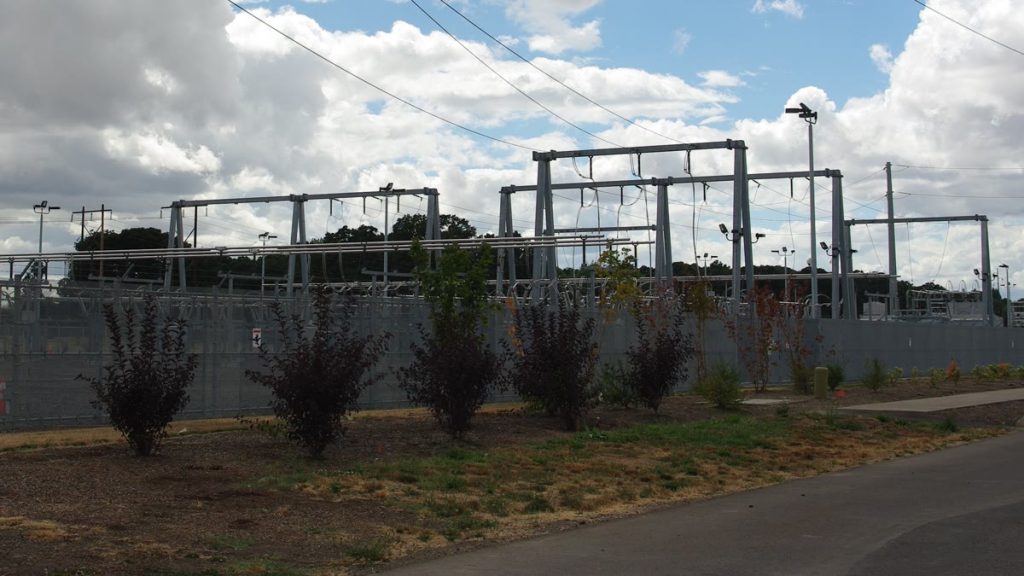
Top image: File photo, 2018: a PGE electrical substation off Starr Boulevard in Hillsboro. Photo: M.O. Stevens, CC BY-SA 4.0, via Wikimedia Commons (cropped).
