Hillsboro: Leak Shuts Regional Water Line at Jackson Bottom; Staff Say Fix Could Top $500,000

- A leak has taken a 42-inch Joint Water Commission pipeline out of service in Hillsboro's Jackson Bottom wetlands.
- The pipe is an intertie linking the commission's North and South transmission lines, says the general manager's report in the Oct.
- Staff began investigating the leak Sept.
A leak has taken a 42-inch Joint Water Commission pipeline out of service in Hillsboro’s Jackson Bottom wetlands. Commission staff estimate the repair could cost more than $500,000, but they report that no customers are served directly by the line and that partner water deliveries “have not been compromised.”
The pipe is an intertie linking the commission’s North and South transmission lines, says the general manager’s report in the Oct. 16 board packet. While it is offline, it “is not available for emergency transmission” between them. Hillsboro is one of four partners, with Beaverton, Forest Grove and the Tualatin Valley Water District, and serves as managing agency.
A repair inside a wetland
Staff began investigating the leak Sept. 17, and the treatment plant’s quarterly report logs an emergency shutdown of the intertie on Sept. 23. The leaking section sits on Clean Water Services land in Jackson Bottom Wetlands Preserve, a 635-acre preserve inside city limits on SW Hillsboro Highway.
The report places the leak “at or near a blowoff,” a valve used to drain a pipeline. Staff call the site difficult to reach, and the exact location and severity can’t be pinned down until crews get to the pipe.
Staff are working with multiple federal, state and local agencies on permits for a temporary access road and for digging in wetland areas, the staff report says. Construction estimates are “in excess of $400,000,” with changed conditions possibly pushing the total above $500,000 once the pipe is dug up. The work itself should take three to four weeks.
Faster than first expected
The overall timeline has moved up. A full repair “was initially anticipated to extend into next summer,” the general manager’s report says. Conditions improved once the line was shut off and the water drained, and repairs are now expected to be finished by the end of this year.
The commission meets only quarterly. On the Oct. 16 consent agenda, staff asked the board to let its executive committee approve repair contracts above the general manager’s $500,000 signing authority. That committee is the chair plus a vice chair from each other partner, and all four must agree. The packet does not record how the board voted.
How much stored water Hillsboro has used
The same agenda item points to a separate strain on supply. Stored-water leasing is normally handled in April, but staff cited below-average summer rain, an early May 22 start to the release season and possible “feed water” needs while the Willamette Water Supply System is readied. They call it “possible” that a partner may need more stored water this season, without naming one.
The release season is when partners can no longer rely on Tualatin River natural flow rights and draw on water stored in Hagg Lake and Barney Reservoir. As of Oct. 4, the commission’s dashboard shows Hillsboro had used 7,183.5 acre-feet and had 2,943.9 left. An acre-foot is about 326,000 gallons.
Dividing each partner’s use by its used-plus-remaining total shows Hillsboro had drawn the largest share of any partner.
| Partner | Used (acre-feet) | Remaining (acre-feet) | Share used |
|---|---|---|---|
| Hillsboro | 7,183.5 | 2,943.9 | 70.9% |
| Tualatin Valley Water District | 3,207.5 | 2,581.5 | 55.4% |
| Beaverton | 4,081.1 | 3,475.0 | 54.0% |
| Forest Grove | 1,219.4 | 3,694.1 | 24.8% |
Used and remaining: JWC Stored Water Summary, year to date as of Oct. 4, 2026 (board packet p. 44). Share used is our calculation: used divided by (used plus remaining).
Hillsboro also accounted for 45.8% of the 15,691.5 acre-feet all four partners had used, again our calculation. The packet does not say whether Hillsboro expects to request a lease.
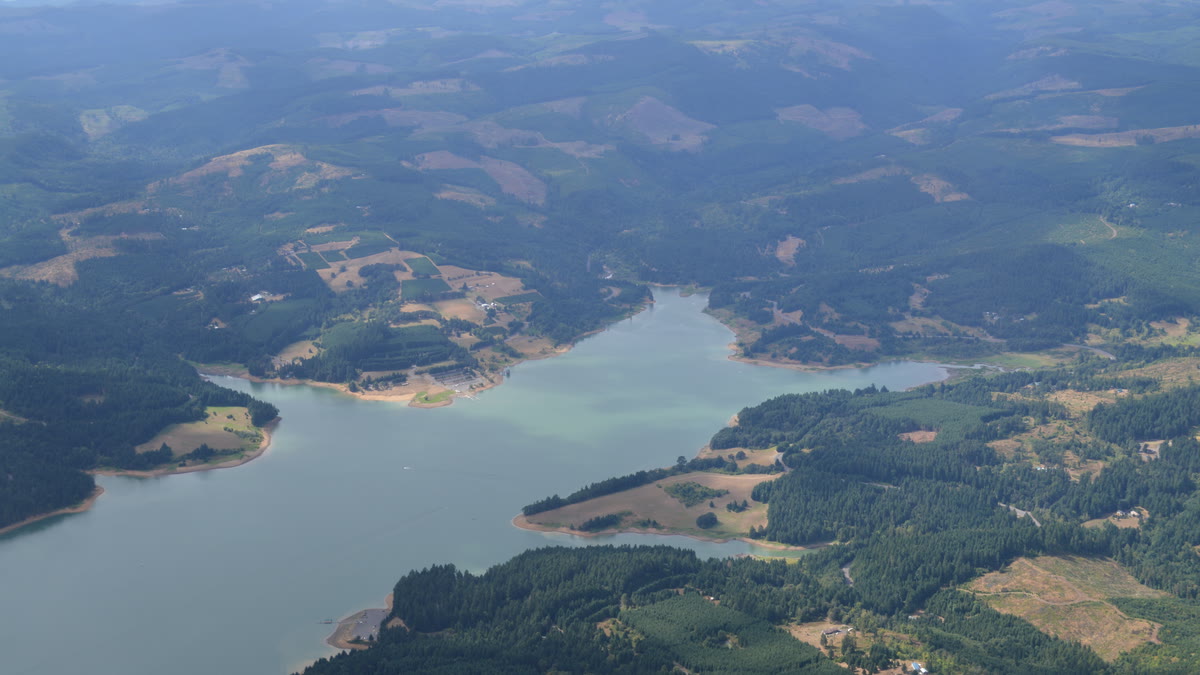
Hagg Lake in a six-year view
Hagg Lake held 19,533 acre-feet on Sept. 30 and was 36.6% full, according to the commission’s storage chart. The Bureau of Reclamation’s daily record for Scoggins Reservoir lists 19,380 acre-feet that day. The packet does not explain the gap.
Federal Sept. 30 readings since 2021 put this year in the middle. At 19,380 acre-feet, 2026 trails 2022 (24,807) and 2024 (24,141) but tops 2023 (16,993), 2021 (15,389) and 2025 (13,947). By Oct. 17, the federal reading had fallen to 15,568 acre-feet.
The commission’s treatment plant averaged 44.9 million gallons a day from July through September, with a peak of 54.1 million. In August, it supplied 804.4 million of the 823 million gallons in Hillsboro’s production report, the Utilities Commission’s Oct. 13 packet shows.
The second source
Hillsboro is also building a different supply. A city rate report in the Oct. 13 packet says the Willamette Water Supply System “will provide Hillsboro with a second water source.” It calls the project a major driver of the proposed water rate increases.
Draft Sept. 15 Utilities Commission minutes put Hillsboro’s investment in the system at $488,176,002 as of July 31. A financial table in the same packet lists $483,376,068 in system capital and operating payments. The packet does not reconcile the two.
Those minutes also record that on Sept. 11, the Willamette system’s own commission authorized its managing agency and general counsel to represent it in mediation over construction claims and disputes at its treatment plant. The minutes do not describe the claims.
The Joint Water Commission’s next regular meeting is Jan. 15, 2027, at the Hillsboro Civic Center, 150 E. Main St.
