U.S.: TRAC Data Show IRS Audited Low-Income Credit Filers at Five Times Others’ Rate in 2021

- Editor's note: This article was first published on March 21, 2022.
- The Internal Revenue Service audited returns from its lowest-income wage earners at five times the rate it audited everyone else in fiscal year 2021, according to a March 8 report from the Transactio…
- TRAC's low-income group covers filers with less than $25,000 in total gross receipts who claimed the earned income tax credit, an anti-poverty credit for working people.
Editor’s note: This article was first published on March 21, 2022. Its original text was lost when Focus Hillsboro rebuilt its website, so it was rewritten and re-checked against the primary sources linked below on Oct. 24, 2026.
The Internal Revenue Service audited returns from its lowest-income wage earners at five times the rate it audited everyone else in fiscal year 2021, according to a March 8 report from the Transactional Records Access Clearinghouse (TRAC) at Syracuse University.
TRAC’s low-income group covers filers with less than $25,000 in total gross receipts who claimed the earned income tax credit, an anti-poverty credit for working people. The clearinghouse said its figures come from internal IRS reports it receives each month under a court order won in Freedom of Information Act litigation.
What TRAC’s figures show
TRAC’s main table for fiscal 2021, which ended Sept. 30, 2021, breaks the numbers down this way:
| Group | Returns filed | IRS audits | Rate per 1,000 |
|---|---|---|---|
| Lowest-income wage earners claiming the credit | 23,620,209 | 306,944 | 13.0 |
| Everyone else | 136,457,242 | 352,059 | 2.6 |
| All taxpayers | 160,077,451 | 659,003 | 4.1 |
Overall, that is about 4 audits for every 1,000 returns, or 0.4%. TRAC said the rate was slightly below fiscal 2019 and above fiscal 2020, when it was 2.9 per 1,000.
By our calculation, the low-income group filed about 14.8% of the returns but accounted for about 46.6% of the audits.
Most of those audits were done by mail. TRAC counted 559,420 correspondence audits, 84.9% of the total, up from 80.4% in fiscal 2019 and 79.5% in fiscal 2020. It said 54% of all correspondence audits went to the low-income credit group.
How higher incomes compared
TRAC reported that 39,449 of the 8,775,144 returns with total positive income between $200,000 and $1 million were audited, a rate of 4.5 per 1,000. That is about one-third of the low-income group’s rate.
Millionaires were audited more often. TRAC counted 13,725 audits against 617,505 returns reporting $1 million or more, which works out to about 22 per 1,000 by our calculation. TRAC noted, though, that this was about a third of the 39,753 millionaire audits the IRS completed in fiscal 2015.
The report also tracked the IRS staff who audit complex returns. Revenue agents on the payroll fell from 14,749 at the end of fiscal 2010 to 8,642 at the end of fiscal 2021, a 41% drop. Tax examiners, who handle simpler cases, went from 12,209 to 12,334.
TRAC described its rates as an approximation. Each one divides the audits completed in a fiscal year by the returns filed in the previous calendar year, even though an audit can involve a return from an earlier year.
The commissioner’s response
The report came up at a March 17 hearing of the House Ways and Means Oversight Subcommittee. Asked about it, IRS Commissioner Charles Rettig said “that report by Syracuse University is absolutely 100% false,” according to the committee’s video at about 41:12.
Rettig pointed members to page 33 and Table 17 of the IRS Data Book for 2020 and said the agency audits high-income taxpayers more than any other group. He also said the IRS must examine a share of earned income credit returns to estimate how much of the credit is paid in error.
The Data Book uses a different measure. It reports the share of returns for a single tax year that the IRS had examined as of Sept. 30, 2020. For tax year 2016, that share was 7.0% for returns showing $10 million or more, 1.2% for returns claiming the earned income credit and 0.6% for returns showing $1 to $25,000.
TRAC answered in a letter dated March 21, signed by co-directors Susan B. Long and David Burnham. It asked Rettig to withdraw the statement and to publish the number of audits the IRS completed in fiscal 2021, by type and size of return. The letter said those counts were last published for fiscal 2019.
The National Taxpayer Advocate, an independent office within the IRS, has also written about mail audits. In her 2021 annual report to Congress, Erin M. Collins, who holds the post, wrote that more than half of the taxpayers in correspondence audits in fiscal 2019 had total positive incomes below $50,000, and most of them claimed the credit.
Collins wrote that the correspondence audit process is “structured to expend the least amount of resources to conduct the largest number of examinations.”
Update, Oct. 24, 2026
In a Sept. 18, 2023 letter to members of Congress, IRS Commissioner Danny Werfel wrote that the agency would be “substantially reducing” correspondence audits focused on certain refundable credits in fiscal 2024, including the earned income tax credit.
Werfel said research had shown that the volume of exams focused on the credit is “a major driver” of disparities in audit rates between Black and non-Black taxpayers.
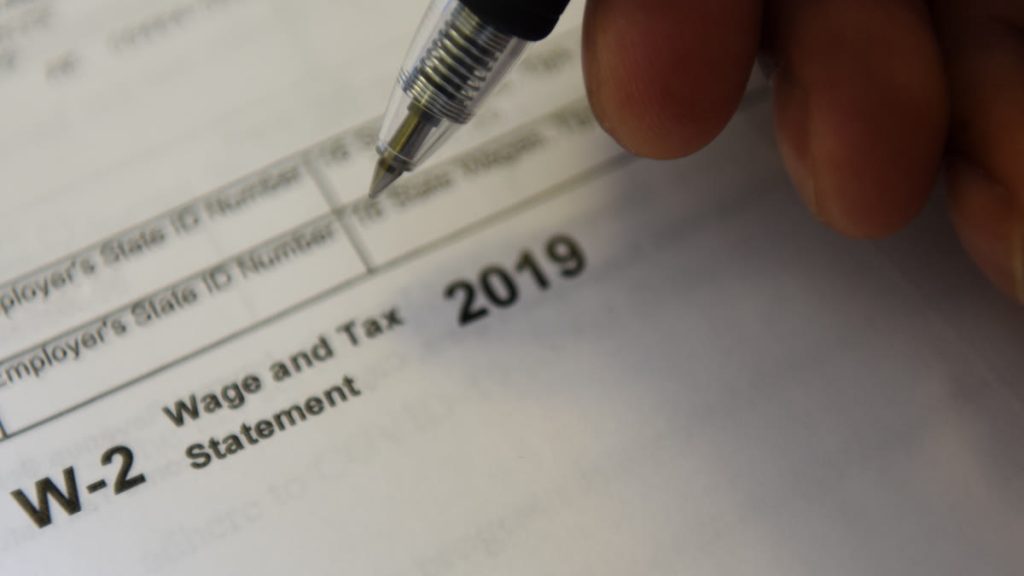
Top image: Illustrative image, 2020: a 2019 Form W-2 Wage and Tax Statement. Photo: U.S. Air Force photo by Airman 1st Class Rhonda Smith, public domain, via Wikimedia Commons (cropped).
