Hillsboro: Arrington Road Sewer Plan Would Need Entry Permits from an Estimated 335 Properties

- Hillsboro city staff propose replacing aging sewer pipes around NE Arrington Road, and the city would need permission from an estimated 335 properties to work on the private pipes that serve them.
- The Nov.
- Rain is the problem the agreement describes.
Hillsboro city staff propose replacing aging sewer pipes around NE Arrington Road, and the city would need permission from an estimated 335 properties to work on the private pipes that serve them. On Tuesday, Nov. 10, the city’s Finance Committee will consider whether to recommend that the City Council approve a deal with Clean Water Services to split an estimated $1 million design cost.
The Nov. 10 committee packet calls it the Arrington Road inflow and infiltration project. That term means storm water and groundwater that seep into sewer lines built to carry only sewage. The staff report says the city recently finished work in its 1911 and 1936 sewer districts, “which was a 20-year effort,” and that this project “will focus on the neighborhood around NE Arrington Road.”
Rain in the pipes, strain downstream
Rain is the problem the agreement describes. Much of the neighborhood’s system is over 50 years old, it says, and flow monitoring showed “a strong correlation between rain events and increased sanitary sewer flows.” That water moves downstream into the Turner Creek sewer system, which “has been at or near capacity” and has had multiple sewage overflows into the creek and nearby wetlands in recent years.
That extra water also has to be treated. The staff report says it takes up room at the sewage treatment plant, “requiring CWS to treat larger flow volumes.” Clean Water Services, which the agreement describes as a county service district, has for years helped pay for replacing certain city sewer lines under a standing agreement. The city and Clean Water Services also each set a share of Hillsboro sewer bills, as Focus Hillsboro reported Oct. 19.
Mains, laterals and who pays for design
The work covers two kinds of pipe. Mains are the public lines under the street, and the agreement lists about 20,000 feet of them, 8 to 12 inches across. Laterals are the smaller 4- to 6-inch pipes that branch off to “adjacent homes and businesses.” The agreement says those are privately owned and puts about 24,000 feet of them in the project.
| Item | Figure in the packet | Where it appears |
|---|---|---|
| Public sewer mains | About 20,000 feet, 8 to 12 inches | Agreement, Section B |
| Private laterals | About 24,000 feet, 4 to 6 inches | Agreement, Section B |
| All pipe combined | About 44,000 feet, roughly 8.3 miles | Our calculation |
| Properties needing permits of entry | An estimated 335 | Agreement, Section B |
| Design cost estimate | $1,000,000 | Staff report |
| Clean Water Services share | 50%, up to $500,000 | Exhibit B |
| City share | 50%, about $500,000 | Exhibit B; dollar figure is our calculation |
Our calculation: 20,000 feet plus 24,000 feet is 44,000 feet, divided by 5,280 feet per mile. The city’s dollar share is the $1 million estimate minus the district’s $500,000 cap.
The project maps’ own pipe summary lists 76 main segments totaling 19,261 feet by our sum, including 689 feet of 6-inch pipe, a size the agreement’s text does not list. Red lines marking “mainlines to be rehabilitated” run along parts of NE Cornell Road, NE Arrington Road and NE Grant Street, plus side streets including NE Barberry Drive, NE Oleander Lane, NE Birchaire Lane and NE Turner Drive.
What a permit of entry asks of owners
Because the laterals are private, the city must first get a “Permit of Entry” from owners. Exhibit B says the city will seek one from “the maximum number of property owners possible” in the project area. The permit lets the city inspect each lateral “and to rehabilitate or replace it if deficient.” The packet does not say whether owners would pay, how long work on a lot would take, or when it would start.
Those signatures also matter for later phases. Exhibit B lets Clean Water Services cut its share of final design and construction costs if fewer than 90% of owners sign. Its share stays at 50% at 90% or more, falls to zero below 70%, and slides in between.
From committee to council, and how to speak
The committee’s vote would be a recommendation only. The agreement says it takes effect after approval by the City Council and by the district’s general manager, or its board when district rules require. The packet does not give a council date. The city would then manage the design, giving the district 10 business days to review the scope and fees and 25 for the evaluation report and preliminary design.
The project comes from the city’s Sanitary Sewer Master Plan, which the council adopted in May 2026. The staff report says public outreach happened through that plan in 2025, not for this agreement. The $1 million is in the current budget, it says, but the packet gives no construction cost or schedule.
Public comment opens the 6 p.m. meeting in Civic Center Conference Room 113, which also runs on Zoom (meeting ID 813-4024-3051); the city’s meeting page links to the agenda. Speakers get three minutes. In person, fill out a yellow card for the City Recorder and bring 10 copies of any written statement.
To speak on Zoom, register with the City Recorder’s Office before 3 p.m. on Nov. 10 by emailing [email protected] or calling 503-681-6269. Remote speakers cannot share screens or turn on cameras; the agenda asks that presentation materials be sent as written testimony.
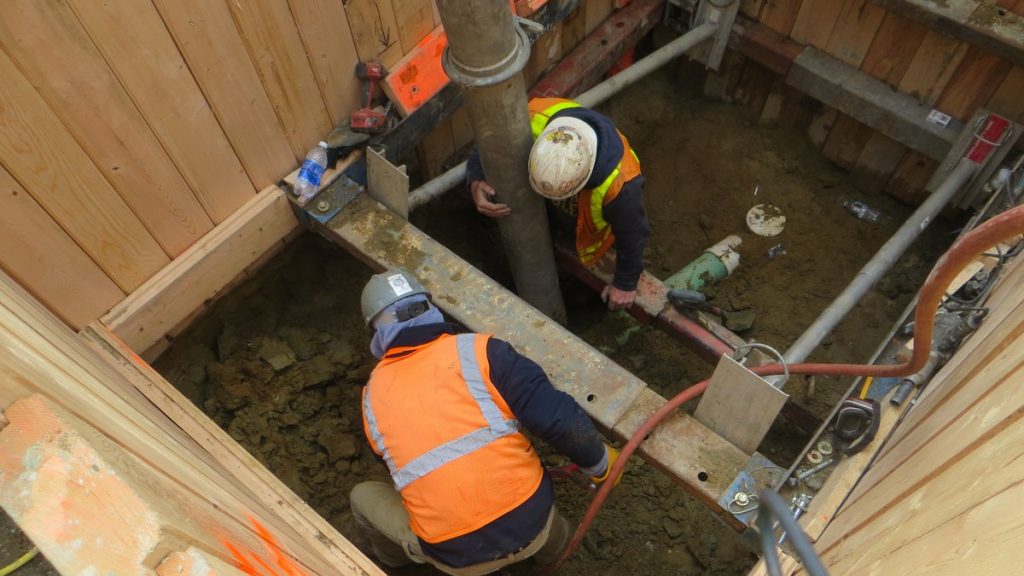
Top image: Illustrative image, 2014: crews work on a sewer lateral in a shored trench in Medford, Massachusetts (not the Hillsboro project). Photo: MassDOT, public domain, via Wikimedia Commons (cropped).
