Hillsboro: School Board to Weigh Pension Bonds and $14.5 Million Land Sale on Oct. 27

- The Hillsboro School District board is scheduled on Tuesday, Oct.
- Neither has been decided.
- PERS, the Public Employees Retirement System, is Oregon's public pension system.
The Hillsboro School District board is scheduled on Tuesday, Oct. 27, to vote on joining a statewide pool of school districts that would sell pension obligation bonds to pay down the district’s pension debt. The same night, according to the meeting agenda, the board will consider approving the $14.5 million sale of about 30 acres of district land in Cornelius to Lennar Northwest, LLC.
Neither has been decided. A staff report in the board packet says the pension resolution “must be enacted by Nov 13, 2026, for the current pooled option to proceed.” It also warns that “future savings are not guaranteed.”
A pension side account ends in 2027
PERS, the Public Employees Retirement System, is Oregon’s public pension system. The resolution puts the district’s share of its unfunded actuarial liability, the gap between promised benefits and money set aside, at an estimated $247,610,926 as of Dec. 31, 2024.
PERS charges the district 6.90% a year on that unpaid balance, the resolution says, because that is the long-term investment return PERS expects. The staff report says one of the district’s PERS side accounts expires in 2027. A side account is a lump sum held at PERS and drawn down to lower the district’s pension rates.
A pension obligation bond refills that kind of account with borrowed money. The district would borrow below 6.90% and deposit the money at PERS; the resolution says this “may reduce costs” if the deposit earns more than the borrowing costs. The bonds could not be sold at a true interest cost above 5.25%, meaning the overall yearly borrowing rate, counting when each payment falls due.
What 10,000 simulations showed
State law requires an independent risk study before a district issues these bonds, and the packet includes one from ECONorthwest dated June 11, 2026. If the deposit earns less than the bonds cost, the firm writes, borrowing is “more costly to the employer than not issuing bonds.”
ECONorthwest ran 10,000 simulations at four interest rates and reported results per $1 million deposited, which it says can be scaled up. This table comes from its Figure 3, in today’s dollars.
| Bond rate | Repayment period | Chance of savings | Average result per $1M | Bad case per $1M (5th percentile) |
|---|---|---|---|---|
| 4.25% | 20 years | 86.9% | $338,760 | −$96,997 |
| 4.50% | 15 years | 78.7% | $223,001 | −$147,281 |
| 4.75% | 20 years | 81.9% | $273,625 | −$136,849 |
| 5.25% | 20 years | 75.7% | $212,860 | −$173,674 |
The resolution’s 5.25% cap matches the highest rate ECONorthwest modeled. At that rate, about one simulation in four did not show savings, meaning a net present value of zero or less (24.3%, our calculation: 100% minus 75.7%). In the worst 5% of cases, the loss was at least $173,674 per $1 million, or 17.4% of the deposit. The firm projected a 7.3% average yearly return, while noting its generic model “may or may not be relevant” to any one employer.
Terms the board would hand to staff
The packet does not say how much the district plans to borrow. The resolution caps the bond at the pension liability reported by the PERS actuary, plus issuance costs, and lets the superintendent or chief financial officer set the final amount and rates “without further action by the Board.”
The bonds would be sold through the Oregon Education Districts Pension Bond Program as Series 2027A, with Piper Sandler & Co. as underwriter. Interest would be federally taxable but exempt from Oregon income tax.
Repayment would be backed by the district’s full faith and credit and taxing power. A state intercept agreement would also let state school money owed to the district go straight to bond payments.
The packet also carries a disclosure state law requires: “the District has not retained the services of an independent municipal advisor” registered with the SEC. The staff report says Piper Sandler, which presented one of the analyses, “is supporting the financial facilitation.”
Land the district bought in 2002
The land for sale is part of about 41.09 acres at 305 SW 345th Avenue that the district bought on or about Jan. 4, 2002, the sale resolution says. The board declared about 30 acres surplus on April 22, 2025, and reaffirmed that on Oct. 28, 2025.
Chief Financial Officer Scott Harrison and Kyle Hayden of Hayden Group negotiated the price, and the district would keep about 10 acres. The agreement with Lennar Northwest, entered into on Oct. 5, 2026, requires board approval within 90 days of its effective date.
The price works out to roughly $483,000 per acre (our calculation: $14.5 million divided by 30 acres; the acreage is approximate). The packet does not say how the district would use the money or describe Lennar’s plans for the site.
Speaking before the votes
The meeting is at the District Administration Center, 3083 NE 49th Place. Audience Time, the public comment period, is set for 7:20 p.m., ahead of the land sale (8:25 p.m.) and bond vote (8:30 p.m.). A pension presentation comes earlier, about 6:15 p.m., during the work session that opens at 5:15 p.m. The agenda says times may change.
Under the district’s public comment rules, in-person speakers must fill out an Intent to Speak form by 7 p.m. in the meeting room. Remote commenters must sign up by 4 p.m. through a Google form to send a written statement, speak over Zoom or be called. The board asks for three minutes or less.
The district’s 2026-27 meeting schedule lists no board meeting between Oct. 27 and Nov. 17, four days after the Nov. 13 deadline.
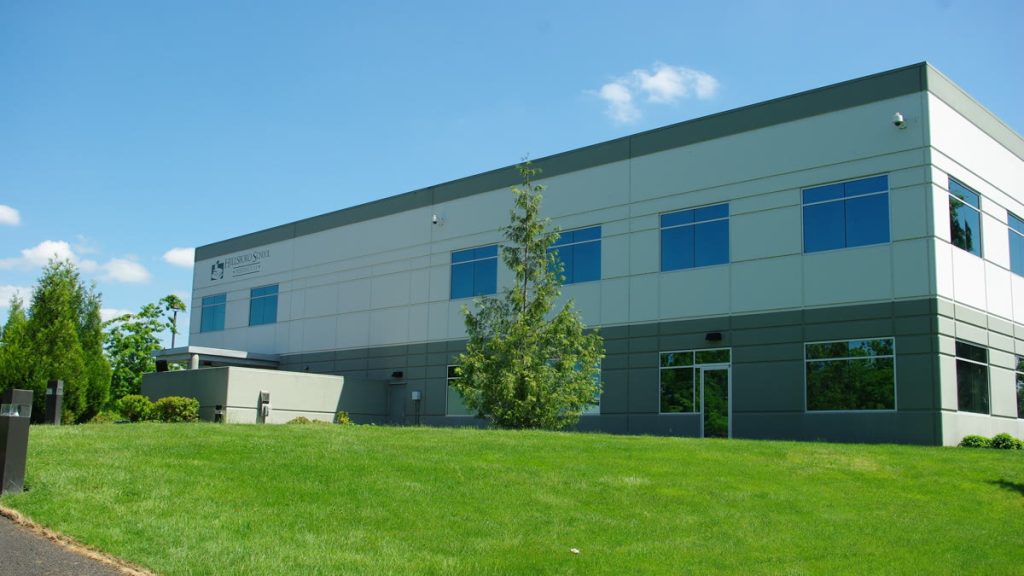
Top image: File photo, 2008: the Hillsboro School District headquarters. Photo: M.O. Stevens, public domain, via Wikimedia Commons (cropped).
