California: Farmworkers Ask Newsom to Back Union Voting Bill After Last Year’s Veto

- Editor's note: This article was first published on April 2, 2022.
- Farmworkers and supporters gathered in 13 California cities on Thursday, March 31, César Chávez Day, to ask Gov.
- Before the rallies, the union asked why the governor would not meet with farmworker leaders on the holiday.
Editor’s note: This article was first published on April 2, 2022. Its original text was lost when Focus Hillsboro rebuilt its website, so it was rewritten and re-checked against the primary sources linked below on Oct. 24, 2026.
Farmworkers and supporters gathered in 13 California cities on Thursday, March 31, César Chávez Day, to ask Gov. Gavin Newsom to support AB 2183, a bill that would give farmworkers a second way to choose a union. The count comes from the United Farm Workers, which listed stops from Calexico to Sacramento.
Before the rallies, the union asked why the governor would not meet with farmworker leaders on the holiday. Newsom’s office confirmed that he and his family were on vacation in Central and South America, CalMatters reported. On Thursday, the UFW announced a summer march from Delano to the Capitol, retracing Chávez’s 1966 route.
What AB 2183 would change
Under current law, once a valid petition is filed, the Agricultural Labor Relations Board directs a secret-ballot election “within a maximum of seven days.” That existing Labor Code language is reprinted in the bill text. CalMatters reported that these elections take place on growers’ property and that advocates say workers feel intimidated during them.
AB 2183, by Assembly Member Mark Stone, a Santa Cruz Democrat, would keep that process but rename it a “polling place election.” It would add an alternative, a “representation ballot card election.”
Under the version amended on March 24, a union could be certified without a polling place election if it filed signed ballot cards from more than 50% of the employer’s current workers.
Each card would go in a sealed envelope provided by the board, signed on the outside by the worker, and could be handed in at a board office or mailed there. A union representative could fill in everything except the signature. The board would keep names as secret as a polling-place ballot, and cards would stay valid for 12 months.
Within five days of receiving a petition, the board would have to decide whether the union had filed enough valid cards. The bill would also let unions obtain an employer’s worker list, set civil penalties of up to $10,000 per unfair labor practice (up to $25,000 for some violations), and require employers who appeal money awards to post a bond.
News coverage, including CalMatters, has described the measure as giving farmworkers the option to vote by mail. The March 24 text does not use the term “mail ballot.” Mailing is one of two ways it allows signed cards to reach the board.
Why Newsom vetoed last year’s bill
Stone’s earlier bill, AB 616, used the same “representation ballot card election” name. It passed the Senate 24-11, and the Assembly gave it final approval 52-19 on Sept. 1, 2021, according to the bill history. Newsom vetoed it on Sept. 22.
In his veto message, the governor wrote that the bill “contains various inconsistencies and procedural issues related to the collection and review of ballot cards.” He also wrote that the U.S. Supreme Court’s 2021 ruling in Cedar Point Nursery v. Hassid “significantly impeded the ability of unions to access agricultural worksites.”
Any update of the state’s farm labor law must account for that ruling, the governor wrote. He directed the Labor and Workforce Development Agency to work with the board and “all relevant stakeholders” on new policies for lawmakers to consider.
Stone’s office and the UFW, the bill’s co-sponsors, told CalMatters they have been working with the governor’s office on the changes he described. Grower associations opposed the bill, and the California Chamber of Commerce put it on its “job killer” list, CalMatters reported.
What farmworkers are asking for
In UFW statements, workers describe the bill as a way to vote without pressure at work. “We deserve to vote where we don’t have supervisors and labor contractors there pressuring us,” vineyard worker Vianey Enriquez said in the union’s March 31 release.
The union also compares the bill to the voting choices Californians had in last September’s recall election, which Newsom survived. Fresno farmworker Lourdes Cardenas made the same point at Thursday’s march, CalMatters reported: “Why can’t we have the same rights?”
As of April 2, AB 2183 was in the Assembly Labor and Employment Committee, where it was re-referred on March 28, according to the bill history. The version introduced on Feb. 15 proposed only nonsubstantive changes to one section of the Labor Code. The election provisions were added on March 24.
Update, Oct. 24, 2026
Newsom approved AB 2183 on Sept. 28, 2022, as Chapter 673, Statutes of 2022. August Senate amendments had replaced the card process with two options, both expiring Jan. 1, 2028: a mail-ballot “labor peace election” where employers agree to make no statements for or against unionizing, and a petition-based “non-labor peace election.”
On May 15, 2023, he signed AB 113, which replaced both with a single “Majority Support Petition” and capped union certifications through it at 75 before 2028.
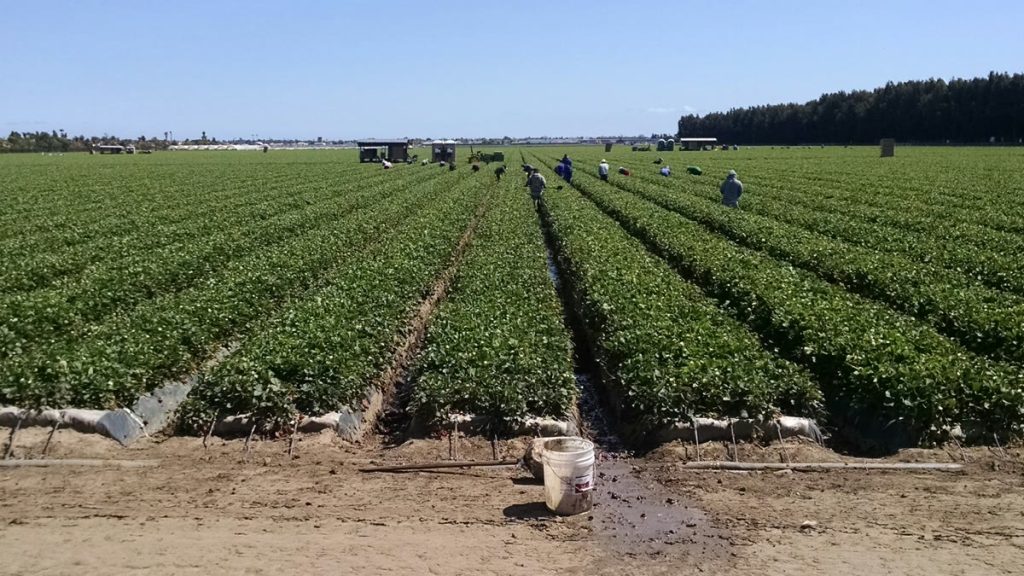
Top image: Illustrative image, 2015: workers in a strawberry field in Oxnard, California. Photo: Fettlemap, CC BY-SA 3.0, via Wikimedia Commons (cropped).
